Tattoo & Pigment
Two ways to break up ink
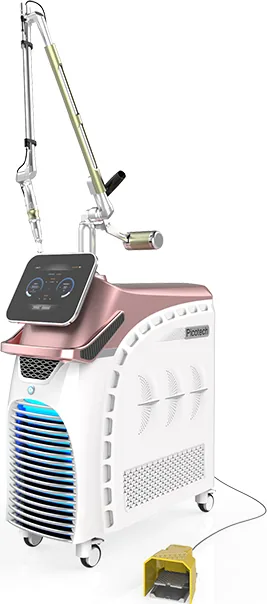
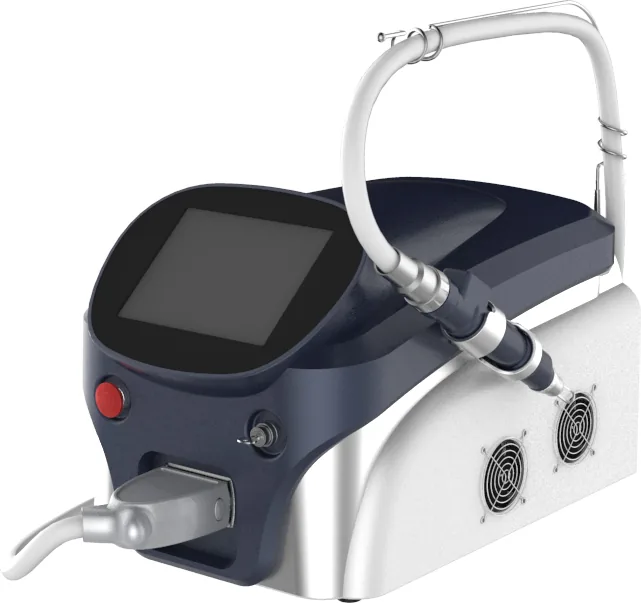
Both platforms shatter dermal pigment into fragments the body can clear. They disagree on how. The Q-switched platform uses nanosecond pulses and up to 2,500 mJ of energy; the picosecond platform uses pulses a thousand times shorter that fracture pigment mechanically rather than by heating it, capped at 800 mJ. Higher energy or shorter pulse — that is the whole trade, and it is not a ranking.
Every figure below is taken from the pages linked on this site as they are published today. Where a specification does not state a value, the cell says so rather than guessing. Nothing here is clinical, legal or regulatory advice, and platform suitability for a given patient or practice is a decision for the treating practitioner.
Side by side
12 dimensions. No column is marked as the winner, because on a spec sheet there isn't one.
| Dimension | Picosecond Nd:YAG Tattoo Removal | Q-Switch Nd:YAG Tattoo Removal |
|---|---|---|
| Pulse duration | 500ps or 800ps | Nanosecond Q-switched pulse |
| How it breaks pigment | Fractures pigment mechanically rather than by heating it | Nanosecond pulses shatter dermal pigment into fragments small enough for the body to clear |
| Maximum energy | 500 mJ at 532nm · 800 mJ at 1064nm | 2,500 mJ |
| Wavelengths | 1064nm, 532nm (650nm and 585nm optional) | Not published — supplied in writing with the quote |
| Pulse modes / heads | Treatment heads: fractional, 585nm, 650nm, cellular | Single pulse / double pulse |
| Spot size | 2–10mm | 2–10mm adjustable |
| Repetition rate | 1–8 Hz | Not published — supplied in writing with the quote |
| Stated ink coverage | Clears difficult ink in fewer sessions and works across a wider range of skin tones | Blue, black, red, yellow, green and brown ink, plus cosmetic lip and brow work |
| Second service from the same console | Fractional lens converts the pulse to gentle pressure that stimulates new collagen without ablating the surface | Second mode targets dilated capillaries and vascular lesions |
| Notable build detail | 90 × 45 × 170 cm · 150 kg | 7-joint Korean articulated arm · Lambda Research Optics (USA) · water temperature and flow-rate monitoring |
| Operator feedback | Not published — supplied in writing with the quote | On-screen energy readout confirms delivered intensity before each pass |
| Regulatory status | Clearance documentation supplied with quote | Clearance documentation supplied with quote |
Every value above is taken from the two device pages as published. Where a figure is not on the specification we have written that rather than filling the gap.
Which fits your practice
They answer different questions. These are the conditions under which each one is the right purchase — read the one that describes your room.
Full specification for the Picosecond Nd:YAG Tattoo Removal →
Not just these two
A two-way comparison is a simplification. These sit alongside it.
Questions
Answered the way we would answer them on the phone.
Neither replaces the other. The picosecond platform uses 500 to 800 picosecond pulses that fracture pigment mechanically rather than by heating it, and is positioned as clearing difficult ink in fewer sessions across a wider range of skin tones. The Q-switched platform delivers up to 2,500 mJ per nanosecond pulse — more than three times the picosecond platform's 800 mJ maximum. Which matters depends on the caseload you actually see.
USBioLongevity does not publish session counts, and no honest supplier can quote one from a specification sheet. Session count depends on ink colour, ink depth, the age of the tattoo, patient factors and the protocol the treating practitioner chooses. The picosecond platform is positioned as clearing difficult ink in fewer sessions than nanosecond pulses — that is a statement about pulse physics, not a number we will put in writing.
The Q-switched tattoo platform's published description covers blue, black, red, yellow, green and brown ink, plus cosmetic lip and brow work. The picosecond platform runs 1064nm and 532nm as standard, with 650nm and 585nm treatment heads available as options — wavelengths added for colours that resist the standard pair. Confirm the exact configuration being quoted before assuming a colour is covered.
Both device pages currently read: clearance documentation supplied with quote. In the United States clearance is granted per device model through a 510(k), not per company, so a clearance held by one platform says nothing about another. We confirm the exact regulatory status of the specific model being quoted, in writing, before you commit to anything.
More comparisons
Unsure what a term on this page means? The glossary defines every wavelength, setting and regulatory route used across the catalog, and the questions page covers ordering, documentation and lead times.
Ask us straight
Specification sheet, clearance documentation, lead time, freight and total landed cost — in writing, with nothing buried. If neither platform fits, we'll say so.
 USBio
USBio